Monica's Birthday Surprise
How buying a camera as a birthday gift led me to learn photography fundamentals, rethink value, and rediscover the joy of learning something new.
William
1/21/20265 min read
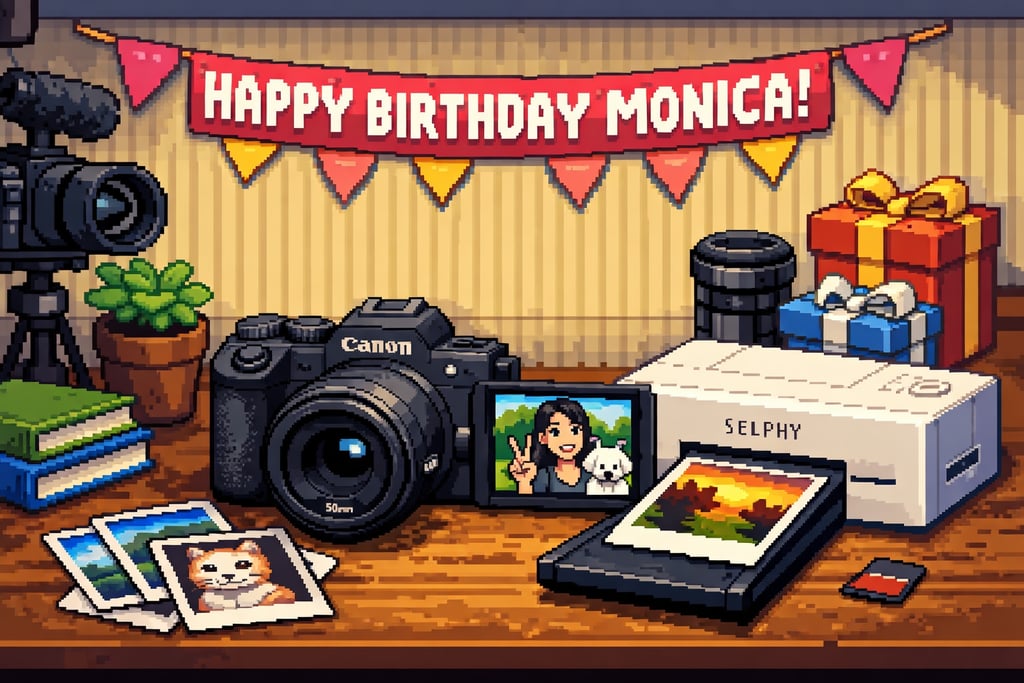
I didn’t set out to become knowledgeable about cameras, this entire journey started as a birthday gift for Monica.
Like most things I buy, I started with a single, very specific idea in my head: Figure out which mirrorless camera offered the best value. This at first meant to me that I wanted to get the Sony ZV‑E10. It looked premium, had a strong reputation, and was constantly recommended in videos and forums as the entry‑level mirrorless camera for creators. On paper, it seemed perfect.
But as with many purchases in my life, the more I researched, the more I realized the right choice wasn’t necessarily the one I first fixated on.
This is the story of how that research rabbit hole led me to the Canon R50 V, a lens upgrade, a crash course in camera fundamentals, a photo printer, and a gift that ended up being far more meaningful than I expected.
The Original Plan: A Modest Budget and a Big Decision
Originally, my budget was far more modest. I started by looking for cameras on Best Buy's website available for local pickup, sorted by price low-to-high. At first I considered the Canon EOS R100 camera which is just under $500. Something simple, capable, and safe. As I learned more, that ceiling crept upward. Cameras under $700 entered the picture, and with them, more serious options.
At that point, I was strongly leaning toward the Nikon Z30. It felt like a sensible middle ground: modern, well‑reviewed, and within reach.
Then came the suggestion that changed the tone of the search: if I could stretch the budget just a little more, the Sony ZV‑E10 was the camera to beat.
That idea stuck.
The Sony ZV‑E10 Temptation
The Sony ZV‑E10 appealed to me immediately. Not just because of its specs, but because it was so frequently positioned as the obvious choice. It has a clean design, a strong sensor, excellent autofocus, and a reputation for being beginner‑friendly while still capable of professional results. It also looks like a serious camera, which matters more than we like to admit.
I was close to buying one...very close. I even saw it go on sale one evening and seriously considered stretching the budget right then.
I didn’t pull the trigger.
The next morning, the sale was gone. That moment forced me to slow down and widen my perspective instead of chasing a deal. I even watched pricing fluctuate daily, hoping to catch a deal that would justify stretching my budget.
Widening the Search
With the Sony temporarily off the table, I extended my research.
I looked at other Sony bodies. Panasonic. Olympus. Nikon again. And Canon, where things became unexpectedly confusing.
I noticed the Canon R50 and R50 V were priced the same. On paper, they looked nearly identical. Choosing between them wasn’t straightforward, especially knowing this camera wasn’t for me.
This camera wasn’t about becoming a YouTuber or a professional photographer. It was meant to:
Capture everyday moments beautifully
Document creative projects
Encourage experimentation and curiosity
Be approachable, not intimidating
Once I framed the purchase that way, the Sony ZV‑E10 stopped being the only answer.
Choosing the Canon R50 V
The decision between the R50 and the R50 V was one of the hardest parts of the process.
The standard R50 has a viewfinder, something many photographers value. The R50 V trades that viewfinder for a more video‑centric design.
I went back and forth.
In the end, I reminded myself of two things:
Monica would likely rely on the rear screen anyway
The Sony ZV‑E10 (my original target) didn’t have a viewfinder either
With that perspective, the R50 V made sense.
After comparing several alternatives, I landed on the Canon R50 V.
How the Gift Was Received
When I finally gave her the camera, her reaction said everything.
She was surprised and then genuinely relieved.
She admitted she had wanted a camera for a while but didn’t feel confident choosing one herself. Having me take that decision off her plate meant she could simply enjoy it, without second‑guessing every option.
That moment validated all the research.
The Lens Upgrade That Changed Everything
The kit lens is perfectly fine. It’s versatile, practical, and forgiving. But curiosity got the better of me, and I added a 50 mm f/1.8 lens to the purchase.
That lens was a revelation.
Suddenly I understood things like:
Depth of field
Subject separation
Why people talk about “bokeh” so much
Photos taken indoors (even in less‑than‑ideal lighting) looked intentional and cinematic. The camera felt less like a gadget and more like a creative instrument.
This single lens upgrade taught me more than any spec sheet ever could.
Falling Into the Learning Rabbit Hole
What I didn’t anticipate was how much I would enjoy learning alongside her.
Once the camera was in hand, something unexpected happened.
I wanted to understand it.
I started learning:
What aperture actually does
Why smaller f‑numbers mean more light
How shutter speed affects motion
When ISO helps and when it hurts
Coming from a technical background, I appreciated that photography is full of trade‑offs rather than “best” settings. Higher numbers aren’t always better. Neither are lower ones.
That learning process became part of the enjoyment.
From Digital to Physical: Buying a Photo Printer
The final twist in this journey surprised even me.
After seeing a few standout photos, I realized something was missing: tangibility.
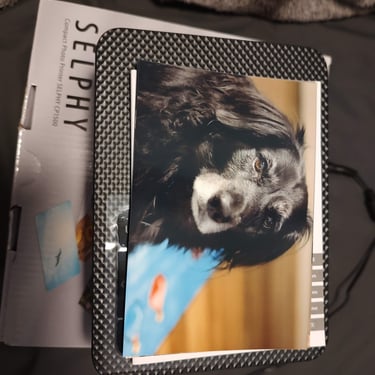
That realization led me to research a photo printer that would pair well with the camera. After hours of research, and more hours looking for the best bargain, I purchased a Canon SELPHY CP1500 photo printer.
Upon using the printer for the first time, I immediately understood why so many people recommend it for printing 4×6 photos. I expected the results to look good, but they genuinely exceeded my expectations. The prints came out quickly, and the quality was surprising in the best way. If someone handed me one without telling me how it was made, I would have assumed it was professionally developed.
The experience itself was just as impressive as the output. I removed the SD card from the camera, inserted it into the printer, and that was essentially it. No apps, no drivers, no fuss. Using the built-in LCD screen, I could easily scroll through the photos, pick my favorites, and start printing within seconds. From capture to physical photo, the whole process felt effortless (almost instant gratification).
I’ve only printed a handful of photos so far, but that first experience made it clear this wasn’t just a novelty purchase. It immediately felt like a natural extension of the camera rather than a separate, complicated device.
What This Experience Taught Me
Looking back, the most important lesson wasn’t about Canon versus Sony.
It was this:
The best tool is the one that invites you to use it.
The Canon R50 V did that for us. It removed friction. It rewarded curiosity. And it pulled me into a creative process I didn’t expect to enjoy this much (even though the camera was never meant to be mine).
I still respect the Sony ZV‑E10. It’s a fantastic camera. But I’m glad I went with the Canon especially after Monica said she prefers the Canon brand of camera.
An Unexpected Gift for Me, Too
Somewhere along the way, this birthday gift became something else. Not ownership, but participation.
Watching tutorials, trying techniques I’d just learned, reviewing results, and passing that knowledge along has been unexpectedly energizing. It feels good to learn something new again.
Final Thoughts
What started as a simple camera purchase turned into:
A better understanding of photography
A deeper appreciation for creative tools
A new hobby that bridges digital and physical worlds
If you’re on a similar journey, my advice is simple:
Don’t rush the decision. Follow the curiosity.
You might be surprised where it leads.